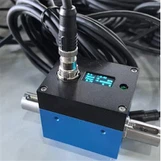


BRG-ZL107 Pulley Tension Sensor To Measure Wire Rope, Metal Wire
A pulley tension sensor is a device used to measure the tension force on a material (such as wire, rope, yarn, or tape) as it passes over a pulley or roller. Here are some key features of pulley tension sensors:
-
Integrated Measuring Amplifier
-
High Accuracy
-
Overload Protection
-
Compact Design
-
Wide Measurement Range
-
Rugged Construction

Technical Parameters
|
|
||
|
Rated quantitative schedule |
N |
20-300 |
|
Output sensitivity |
mV/V |
2.0±0.1% |
|
Zero point output |
%F.S. |
±1 |
|
Non-linear |
%F.S. |
0.1 |
|
lag |
%F.S. |
0.1 |
|
Repeatability |
%F.S. |
0.1 |
|
Creep (30 min) |
%F.S. |
0.1 |
|
Temperature sensitivity drift |
%F.S./10℃ |
0.05 |
|
Zero temperature drift |
%F.S./10℃ |
0.05 |
|
Response frequency |
Hz |
1k |
|
Material |
42CrMoA |
|
|
impedance |
Ω |
350 |
|
Insulation resistance |
MΩ/100V DC |
≥5000 |
|
Use voltage |
V |
5-15 |
|
Operating temperature range |
℃ |
-20-80 |
|
Safety overload |
%R.C. |
150 |
|
Extreme overload |
%R.C. |
200 |
|
Cable line specifications |
m |
Φ5*3m |
|
Cable limit pull force |
N |
98 |
|
TEDS |
selectable |
|
Dimension (mm)


Force Diagram


Yarn is extremely lightweight; if a single-wheel system is used alone, slippage occurs easily, resulting in unstable measurements.
Three-Pulley Structure:
- Increases friction
- Enhances stability
- Prevents yarn bouncing
- Practical Benefits:
- Maintains constant yarn tension
- Prevents yarn breakage
- Improves fabric quality

Why is the Three-Pulley Configuration Ideal?
Because the electrode sheets are extremely thin and run at high speeds, they are prone to lateral deviation.
The three-pulley system enables the following: stabilizing the material's running trajectory, enhancing the precision of tension detection, and minimizing the impact of vibrations.
Key Functions:
- Prevents electrode wrinkling
- Ensures uniform winding
- Stabilizes coating quality
- Improves battery consistency

Why does the web processing industry favor the three-roller configuration?
Because at high operating speeds, materials are prone to fluttering, drifting, and vibrating. The three-roller structure ensures significantly more stable material transport.
Practical Benefits:
- Monitors web tension
- Synchronizes unwinding and rewinding
- Enhances print registration accuracy
- Prevents film wrinkling

Suitable for tension measurement of various optical fibers, yarns, chemical fibers, metal wires, wires, cables, tapes, and steel strips.
Widely used in electronics, chemical industry, and textile. Papermaking, machinery and other fields, with high measurement accuracy, reliability and stability in the field of tension measurement

High Precision, Stable Measurement
The sensor has a built-in overload protection mechanism and is strictly tested before leaving the factory, thus ensuring the measurement accuracy, stability and reliability of the product.


Stable Structure And Corrosion Resistance
It adopts a double hole structure design, can be used for tension and compression, and has good output symmetry; it is easy to install, light in weight, and can adapt to the swing of the wire rope during movement, and has a good force measurement effect.
Fixed End, Install Application
Provide installation guidance, simple installation and maintenance


The type of output signal provided by the pulley tension sensor is crucial for integration with control systems or data acquisition equipment.
The common output signal types include 0-10V, 4-20mA, and mV/V, and etc which match with the existing infrastructure.
Made of high-quality 42CrMo alloy steel with rounded chamfers, fine sandblasted appearance, long service life, and high structural hardness. Stainless steel is optional.

Our Equipment


FAQ
Q: Can we use our own logo?
Q: Could I visit your factory?
Q: How can you make delivery ?
Q: What is the payment term ?
Q: How do you measure the tension of a cable?
Q: What is the function of the tension sensor?