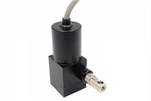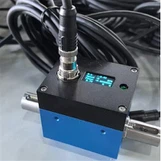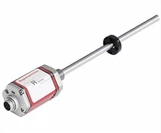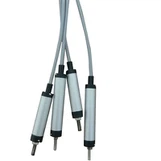


PY2 Gefran Replacement Linear Potentiometer Position Sensor Supplier
This mini position transducer is designed for direct absolute measurement and available in stroke length up to 50mm. The mini design is suitable for mounting in instruments or machines with limited space and specially design for cam-following application.An improved technique for making connection toresistance track (Double Trimming Technique)ensures the higher degrees of reliability and linearity, while multi-fingers wipers stabilize output signals, even in the most adverse working conditions.
The fixing feet are adjustable to the desired positions.


- 1. Harden steel ball head for measurement of cam-following application
- 2.Mini design for limited space·
- 3.Anodised Aluminium Housing
- 4.Double slide and bearing·
- 5.Very Long Life >100x 10⁶ Cycles >25x10⁶ m
- · Stroke :10-50mm
- · Outstanding Linearity up to :+0.1%
- · High Resolution : Infinite
- Excellent Repeatability· :+0.01mm
- · Max operating speed· :5m/s max.
- PY2C - 4-pin C193 connector·
- PY2FS - standard 1m cable·
- Sealing IP 40 standard (IP 65 optional)·
- Fuse Protected optional·
- Anti - rotating shaft device optional
Dimension (mm)


Applications :

Linear displacement sensors are suitable for installation in confined spaces and are ideal for position detection in various types of equipment, such as injection molding machines, die-casting machines, rubber processing machines, shoemaking machinery, EVA injection molding machines, blow molding machines, woodworking machinery, hydraulic presses, packaging machinery, printing machinery, tunnel boring machines, and others.
Installation methods
Installation Method 1: Fixed Body + Measuring Rod Contacts Moving
Features:
- Simple installation
- Lowest cost
- Most widely applied
Suitable for:
- Cylinders
- Push rods
- Sliders
Installation Method 2: Ball-Contact Mounting
Utilizes the ball tip at the end of the probe rod.
Advantages:
- Automatically compensates for slight eccentricity
- Reduces lateral forces
- Extends service life
Installation Method 4: Cam-Based Detection
Suitable for rotary mechanisms.
Function:
- Converts rotary motion into linear displacement
- Detects equipment operating status
Certificates

Certificate

Certificate

Certificate

Certificate

Certificate
FAQ
Q1: What is this linear displacement sensor used for?
This sensor is designed to measure linear position, displacement, and movement in industrial equipment. It is widely used in automation systems, hydraulic cylinders, injection molding machines, packaging machinery, woodworking equipment, and industrial robots.
Q2: Can it be connected directly to a PLC?
Yes. The sensor can be connected directly to most PLCs and control systems. Common output signals include:
0-5V
0-10V
4-20mA
It is compatible with Siemens, Mitsubishi, Omron, Delta, and many other PLC brands.
Q3: How do I choose the correct measuring range?
The sensor range should be slightly larger than the actual travel distance. It is recommended to leave 10%-20% extra stroke to prevent damage caused by over-travel.
For example:
Actual travel: 100 mm
Recommended sensor range: 125 mm or 150 mm
Q4: Why is proper alignment important during installation?
The sensor rod should move in a straight line without side loading. Misalignment may cause:
Reduced accuracy
Signal instability
Premature wear
Shorter service life
Proper alignment ensures the best performance and longevity.
Q5: What should I do if the output signal is unstable?
Please check the following:
Stable power supply
Proper grounding
Shielded signal cable
Distance from motors, inverters, or other interference sources
Electrical noise is one of the most common causes of unstable signals.
Q6: Can the sensor be customized?
Yes. Custom options typically include:
Special stroke lengths
Different output signals
Customized mounting dimensions
Extended cable lengths
Waterproof versions
OEM and machine manufacturers often request customized solutions.
Q7: What is the expected service life?
Under normal operating conditions, the sensor can achieve millions of movement cycles. Actual lifespan depends on installation quality, operating frequency, and environmental conditions.
Q8: Should I choose a voltage output or a 4-20mA output?
Voltage Output (0-5V / 0-10V)
Suitable for:
Short cable runs
Low-noise environments
Advantages:
Simple wiring
Lower cost
4-20mA Output
Suitable for:
Industrial environments
Long-distance signal transmission
Advantages:
Excellent noise immunity
More stable signal transmission
Q9: Can the sensor operate in dusty or oily environments?
Yes. Industrial-grade sensors are designed for harsh environments and typically feature:
Durable metal housing
Dust-resistant construction
High protection ratings
Some models offer IP65 or IP67 protection.
Q10: Does the sensor require calibration before use?
Most sensors are factory-calibrated and ready for installation. For high-precision applications, additional system calibration may be performed after installation.
Q11: Why should I avoid over-travel?
Exceeding the sensor's rated stroke may cause:
Internal mechanical damage
Bent rod
Signal errors
Permanent sensor failure
Always select an appropriate measuring range and leave a safety margin.
Q12: Can the cable length be extended?
Yes. When extending cables, it is recommended to:
Use shielded cables
Keep signal cables away from power cables
Choose 4-20mA output for long-distance transmission
This helps maintain signal quality and reduce interference.
Q13: How accurate is this linear displacement sensor?
The sensor offers:
High repeatability
Excellent linearity
Fast response time
It is suitable for precision position monitoring and closed-loop control applications.
Q14: How can I maximize the sensor's service life?
To achieve the longest lifespan:
Avoid side loads on the rod
Prevent over-travel
Ensure proper alignment
Minimize excessive vibration
Inspect wiring regularly
Correct installation and maintenance are essential for reliable long-term operation.
Q15: Can the sensor be used outdoors?
Yes, provided that the sensor has an appropriate protection rating (such as IP65 or IP67). For outdoor applications, additional protection against water, dust, and direct sunlight is recommended.