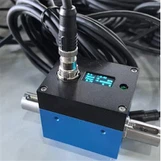


BRG9500 Disc Torque Sensor
Product Introduction
Disc torque sensors are designed for easy integration into servo or stepper motor systems, using strain gauge technology for accurate torque measurements. Made from durable stainless steel, they have a low non-linearity of just 0.3%, ensuring high accuracy.
We can offer various measuring ranges-50 N·m, 100 N·m, 200 N·m, 500 N·m, and 1000 N·m-allowing users to choose the right option for their needs. Their low-profile, through-hole design and flange-to-flange mounting enable compact integration into robotic systems.
By providing real-time torque data, the sensors enhance joint motion control, leading to smoother and more precise movements. This is especially beneficial in applications like collaborative robotics, surgical robotics, and delicate assembly tasks.

features
Torque sensors are high-precision measuring devices that are widely used in industry and machinery, especially in situations where the torque of rotating parts needs to be monitored. Here are some of the main features of torque sensors.
High accuracy based on strain gauge technology
Torque sensors usually use strain gauge technology, which allows them to provide extremely high measurement accuracy. Strain gauges work by detecting the tiny deformation of the material when torque is applied. This method ensures that the sensor has extremely low nonlinear errors during measurement, usually within 0.3%, thus ensuring the reliability and accuracy of the data.
Stability and reliability
Torque sensors are designed with stability and reliability in mind and can continue to work under various environmental conditions. They are usually made of corrosion-resistant stainless steel materials and are suitable for harsh environments. In addition, the electronic components inside the sensor are carefully designed to reduce the impact of external interference on the measurement results. This stability allows the torque sensor to maintain its performance over long-term use.
Low-range torque measurement
Torque sensors are capable of low-range torque measurement, which makes them excellent in micro-torque applications. Low-range measurement capabilities are particularly important for applications that require fine control, such as robotic joints or precision machinery.
Easy installation
It is usually designed with flange connection, which is easy to install and integrate into existing systems. The flange connection structure not only enhances the mechanical strength of the sensor, but also simplifies the connection process with other equipment, allowing users to quickly deploy and replace sensors.
Versatile applications
Torque sensors are widely used in many fields such as automobiles, aerospace, and manufacturing. They can be used for real-time monitoring and control of equipment such as engines, reducers, and motors, helping engineers optimize system performance and prevent potential failures.
Easy to use
They are designed with user experience in mind, and are usually equipped with simple and clear interfaces and operating guides, allowing users to easily install and use them. This ease of use reduces training costs and improves work efficiency.
Technical Parameters of Disc Torque Sensor
|
parameter |
Technical index |
|
parameter |
Technical index |
|
range |
0-50, 100, 200, 500, 1000Nm |
Output resistance |
700±5Ω |
|
|
Sensitivity |
1.5±10% mV / V |
Insulation resistance |
≥5000MΩ/ 100VDC |
|
|
Zero output |
±2% F.S. |
Excitation voltage |
10-15VDC |
|
|
Non-linear |
±0.1, 0.3% F.S. |
Temperature compensation range |
-10 ~ 60℃ |
|
|
Hysteresis |
≤±0.05% F.S. |
working temperature |
-20 ~ 65℃ |
|
|
Repeatability |
≤±0.05% F.S |
Safety overload |
150% F.S. |
|
|
Creep |
≤±0.03% F.S/30min |
Extreme overload |
200% F.S. |
|
|
Temperature sensitivity drift |
0.03% F.S. / 10℃ |
Cable size |
Ø5.2×3m |
|
|
Zero temperature drift |
0.03% F.S. / 10℃ |
Electrical connections |
red/E+, black/E-, green/S+, white/S- |
|
|
Input resistance |
750±10Ω |
Material |
stainless steel or alloy steel |
Dimension (mm)


applications
Robot torque sensors are essential for measuring joint torque in robotic systems, facilitating smoother and more precise motion control. Their applications span various fields, particularly in robotics, where they enhance the functionality and safety of robots.
Joint Torque Measurement
Robot torque sensors are primarily used to measure the torque exerted at joints during movement. This data is crucial for controlling the force applied by robotic arms, ensuring that movements are executed smoothly and accurately. By monitoring joint torque, engineers can optimize the performance of robotic systems, making them more responsive and effective in their tasks.
Collision Detection
These sensors play a vital role in collision detection. By measuring the torque at joints, robots can detect unexpected forces that may indicate a collision with an object or person. This capability is especially important for collaborative robots (cobots) that operate alongside humans, as it allows them to react appropriately to avoid accidents and ensure safety.
Force Control
In applications where precise force application is necessary, such as assembly tasks or surgical robots, torque sensors provide real-time feedback that helps maintain the desired force levels. This feedback loop enables robots to adjust their actions dynamically based on the torque measurements, enhancing accuracy and effectiveness.
Performance Optimization
By analyzing joint torque data, engineers can identify inefficiencies in robot movements and make necessary adjustments to improve overall performance. This analysis can lead to better energy efficiency and longer operational life for robotic systems.
Integration with Control Systems
Robot torque sensors are often integrated into advanced control systems that utilize the torque data to refine motion planning and execution. This integration allows for more sophisticated control strategies, including adaptive learning where robots improve their performance over time based on past experiences.
Research and Development
In research settings, these sensors are invaluable for studying robotic dynamics and kinematics. They provide essential data for developing new algorithms and improving existing robotic technologies.

Package

FAQ
Q: Can we use our own logo?
A: Yes, we can print your private logo according to your request.
Q: Could I visit your factory?
A: Of course,we warmly welcome you to visit our factory.
Q: How can you make delivery ?
A: We can delivery all the over the world . We can send by air express , such as DHL, Fedex , UPS and etc. We can also delivery by sea
Q: What is the payment term ?
A: We can accept T/T , western union and etc . For big quantity , 30% down payment and 70% payment before delivery